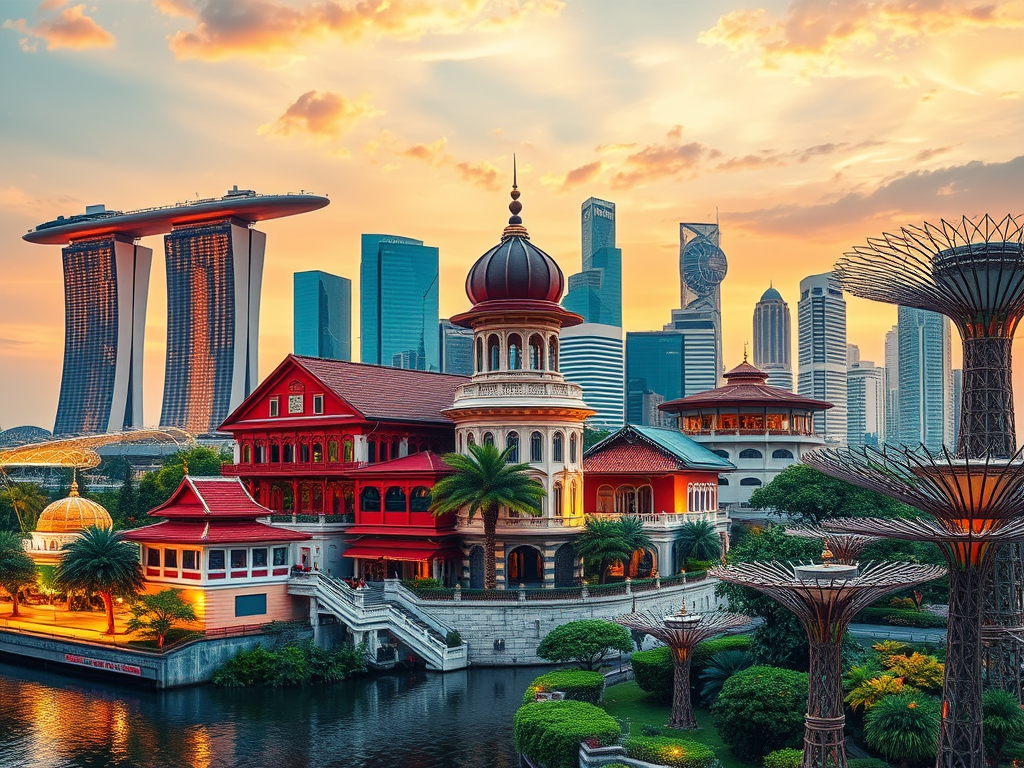
Singapore doesn’t greet you so much as it unfolds, in layers of light, ritual, and quiet precision. Even before you step into the city, Changi Airport sets the tone: butterfly gardens, waterfalls, orchids, and a level of efficiency that feels almost choreographed. Almost 70 million passengers yearly passing through and completely hassle free. It’s the kind of airport that makes you forget you’re in transit. And from India, the journey is astonishingly close, a smooth five hours from Bengaluru, with Singapore Airlines and IndiGo offering effortless non‑stop flights that make the island feel like a familiar neighbor rather than a distant destination.

For Indian travelers, Singapore has long been a place of comfort and curiosity. Tamil appears on signboards alongside English, Mandarin, and Malay, not as a symbolic gesture, but as recognition of the community that helped build this island. By the early 1900s, Tamils formed the largest segment of Singapore’s Indian population, shaping its labor force, its culture, and its early neighborhoods. Tamil became a national language because it was the language of the people who laid the foundations of the city. The island feels less like a distant destination and more like a familiar neighbor, just one that runs on a slightly more synchronized clock.
Click here to see all photos from Singapore
Where Myth Meets the Sea
Singapore’s story begins long before the skyscrapers. In the 14th century, Sumatran prince Sang Nila Utama landed on the island of Temasek and, upon seeing a creature he believed was a lion, renamed it Singapura – the Lion City. When I read this, my eyes lit up, for those who know me, know how I firmly believe that many English words trace their etymology to Tamil and this one is actually true. Today, the Merlion at Marina Bay stands as a sculpted reminder of that legend. Its lion head symbolizes courage and sovereignty, while its fish tail pays homage to Temasek, the humble fishing village that once lived by the tides. The Merlion is more than a mascot; it is a metaphor for Singapore itself, strength above, roots below.


A Nation Built Twice
Singapore’s modern history reads like a compressed epic. The arrival of Sir Stamford Raffles in 1819 transformed the island into a free‑trade port, drawing migrants from China, India, and the Malay Archipelago. Colonial buildings rose along the waterfront, including the grand Raffles Hotel, where the Singapore Sling was born, a drink that today costs over 50 USD, a reminder that some experiences are priced for nostalgia as much as taste.

World War II brought a darker chapter. The Japanese occupation left deep scars, still felt in places like the Battlebox at Fort Canning and the Changi Chapel and Museum. Yet from this turbulence emerged a remarkable reinvention. Expelled from Malaysia in 1965, Singapore became an independent nation with no natural resources, only determination. What followed was one of the most extraordinary transformations of the 20th century: a leap from third world to first, powered by discipline, innovation, and an unshakeable belief in the future.

The City That Dreams in Glass
Nowhere is that future more visible than at Marina Bay Sands, a structure that rises like a ship suspended in the sky. Its three towers hold up a skypark longer than the Eiffel Tower laid on its side, and its infinity pool has become a global icon of the “New East.” But the real magic lies on the SkyPark Observation Deck, where the city unfurls beneath you in a 360‑degree panorama. From up there, Singapore looks like a living circuit board , the bay shimmering like polished glass, the Supertrees glowing in the distance, and the ships anchored offshore forming a constellation of lights on the water. At sunset, the skyline blushes gold; by night, it becomes a galaxy of neon.

Across the bay, Gardens by the Bay glows like a vision from science fiction. The Supertrees, towering vertical gardens, harvest solar energy by day and erupt into choreographed light shows by night, their branches pulsing with color in time to music. Threaded between them is the OCBC Skyway, a slender aerial bridge suspended 22 meters above the ground. Walking along it feels like drifting through the canopy of a futuristic forest, the city skyline on one side, the glowing Supertrees on the other, and the bay shimmering beneath your feet. At dusk, the skyway becomes a front‑row seat to the Garden Rhapsody light show, where the Supertrees ignite in waves of color that ripple through the night.


Inside the cooled conservatories, the Flower Dome recreates Mediterranean climates, while the Cloud Forest wraps visitors in mist, orchids, and a stunning 30‑meter indoor waterfall. It is sustainability rendered as spectacle — a place where nature and technology don’t compete, but collaborate. And during the end‑of‑year season, the entire bay transforms into something even more enchanting. Christmas Wonderland takes over the Gardens, turning the Supertree Grove into a glowing fairytale of light sculptures, festive markets, carousels, and snowfall shows that feel almost surreal in the tropical warmth. The air fills with music, laughter, and the scent of holiday treats, and the whole Marina Bay area becomes a luminous celebration — a reminder that Singapore knows how to dress it up for the holidays.


Every evening, the bay transforms into a theater. The Spectra Light & Water Show sends jets of water, lasers, and color across the Marina, turning the skyline into a shimmering backdrop. A river cruise from Clarke Quay brings you closer, gliding past Boat Quay’s riverside restaurants, Clarke Quay’s neon reflections, and Robertson Quay’s quieter, residential charm. The quays are the city’s social spine: lively, walkable, and full of stories.


Neighborhoods as Emotional Landscapes
Yet, Singapore’s magic lies not only in its futuristic skyline but in the way its neighborhoods hold contradictions without conflict.
Chinatown is a tapestry of red lanterns, herbal shops, and incense drifting through the air. The Sri Mariamman Temple, the oldest Hindu temple in Singapore, rises in a riot of sculpted deities, its gopuram a burst of color against the sky. Just a short walk away, the Buddha Tooth Relic Temple glows with Tang‑style grandeur, its interiors shimmering with gold and quiet devotion. But Chinatown is more than its temples.


Wander down Pagoda Street and you’ll find calligraphy stalls, tea houses, and shops selling everything from jade pendants to hand‑painted fans. Smith Street transforms into a food street by evening, where the scent of chili crab, Hainanese chicken rice, and smoky satay fills the air. Duck into a traditional medicine hall and you’ll see drawers of herbs and roots that have been used for centuries. Turn a corner and you might stumble upon a hidden bar tucked behind an unmarked door, or a café serving pandan‑infused pastries.

Sri Mariamman Temple sits at 244 South Bridge Road and is recognised as Singapore’s oldest Hindu temple, founded in 1827 by Naraina Pillai and later gazetted as a National Monument in 1973. Its five‑tiered Dravidian‑style gopuram, rebuilt in 1925, is packed with brightly painted deities, guardians, and mythological figures crafted by artisans from South India. Much of the current brick structure dates back to the 1840s, and the temple once served not only as a place of worship but also as a refuge for new immigrants, a venue for community mediation, and an early registry for Hindu marriages. Today it remains an active cultural hub, especially during the annual Theemithi fire‑walking festival, drawing both devotees and visitors into one of Chinatown’s most historically layered spaces.


Little India, by contrast, is a riot of color and sound, a neighborhood that feels like stepping into a festival that never ends. Jasmine garlands perfume the air, silk shops spill their fabrics onto the sidewalks, and the Sri Veeramakaliamman Temple rises in a vibrant mosaic of deities, its façade alive with mythology.

There is always a ceremony happening there and the sound a nadhaswaram and a mridangam area always present. The streets pulse with energy: Bollywood music drifting from storefronts, aunties bargaining over bangles, and the aroma of masala dosa, biryani, and freshly fried vadai wafting from cafés. Tekka Centre adds another layer: a hawker hall where fishmongers, spice sellers, and food stalls create a sensory symphony. And then there’s the art – murals splashed across alley walls, celebrating Tamil culture, migration, and identity. Little India feels like a parallel Bengaluru, familiar yet distinctly Singaporean, shaped by migration and memory.

Mustafa Centre, open 24 hours, is a universe of its own, a maze of electronics, perfumes, snacks, and souvenirs where you can buy anything from gold jewelry to Japanese KitKats at 2 a.m.

Kampong Glam offers a different rhythm altogether, one I walked into in my early morning walk. It is a neighborhood where heritage and hipness walk side by side. The golden dome of the Sultan Mosque anchors the district, its presence serene and majestic.

Around it, Arab Street and Bussorah Street unfold like a woven carpet of textiles, perfumes, and Middle Eastern flavors. You can sip mint tea in a Moroccan café, sample Turkish ice cream from a street vendor, or browse shops selling hand‑woven carpets, oud fragrances, and intricate lanterns. Haji Lane, narrow and vibrant, is Singapore’s bohemian heart, a corridor of indie boutiques, vintage stores, and street art that turns every wall into a canvas. The cafés here feel like creative studios: minimalist interiors, cold brews, and pastries that look like sculptures. As evening falls, the neighborhood shifts again, music spills from bars, shisha lounges glow under fairy lights, and the streets hum with a youthful, cosmopolitan energy. Kampong Glam is a place where old stories find new expressions, where tradition is not preserved in glass but lived, adapted, and celebrated.


Sultan Mosque, officially known as Masjid Sultan, is one of Singapore’s most important religious and historical landmarks. Completed in 1824 for Sultan Hussein Shah, it became the central mosque for the Malay-Muslim community in Kampong Glam. The building you see today is largely the result of a major reconstruction finished in 1932, designed by Denis Santry of Swan & Maclaren. Its most distinctive feature is the pair of large golden onion-shaped domes, each ringed with black glass bottles — a detail funded by donations from poorer residents at the time. The mosque can accommodate up to 5,000 worshippers and was designated a national monument in 1975. It remains an active religious institution and a key cultural anchor in the Kampong Glam conservation district.

And in the Civic District, Singapore’s colonial past stands in elegant conversation with its present. St. Andrew’s Cathedral, serene and white, has watched over the city since 1861. Nearby, the Padang stretches out like a ceremonial carpet, the very ground where independence was proclaimed. The National Gallery, housed in the former Supreme Court and City Hall, blends stone and glass in a way that mirrors the country’s own fusion of tradition and modernity. Fort Canning Park, with its ancient Malay history and wartime bunkers, offers a green refuge in the heart of the city.

Where Nature Becomes a Story
For families, Singapore is a wonderland — a place where nature, imagination, and storytelling blend so seamlessly that even adults feel a quiet sense of awe. The Mandai Wildlife Reserve is at the heart of this magic, a constellation of experiences that turn the natural world into something intimate and unforgettable. The Singapore Zoo, with its open habitats and gentle transitions between ecosystems, feels less like a zoo and more like a walk through living geography. The Night Safari, lit only by moonlight and soft amber lamps, transforms the forest into a nocturnal theatre where hyenas, leopards, and civets move like shadows. Bird Paradise, with its sweeping aviaries and cascading waterfalls, surrounds you with color and sound — a reminder that the sky itself can be a habitat.


But it was River Wonders that we chose to visit on this trip, and it became one of the most memorable chapters of our journey. The Amazon River Quest carried us past jaguars lounging in the sun, giant anteaters shuffling through the undergrowth, and capybaras soaking in their quiet corners of the world. The Giant Panda Forest offered a moment of stillness with the celebrated Le Le and Jia Jia — a kind of soft, unhurried joy that only pandas can evoke. And the Amazon Flooded Forest, with its manatees drifting like underwater clouds, felt almost meditative. River Wonders is not just a park; it is a narrative of rivers, ecosystems, and the fragile beauty of the natural world. And yes — the pandas were, without question, the cutest.


Click here to see more photos from Mandai River Wonders

The Singapore Botanic Gardens, a UNESCO World Heritage Site, offers a different kind of serenity. Its rainforest trails, swan‑filled lakes, and the National Orchid Garden create a sanctuary where mornings feel soft and unhurried. Children run freely on the lawns, families picnic under ancient trees, and the air carries the scent of orchids and rain.
Yet Singapore’s magic for children extends far beyond its green spaces. The ArtScience Museum, shaped like a lotus blooming along the bay, turns learning into play. Its interactive exhibits — shifting lights, responsive floors, digital waterfalls — invite children to touch, explore, and imagine. Universal Studios on Sentosa adds a different kind of thrill: roller coasters that twist above palm trees, cinematic worlds brought to life, and the kind of laughter that only comes from shared adventure. Even the S.E.A. Aquarium, with its vast blue tunnels and drifting rays, feels like stepping into another universe.

Everywhere you go, the city seems designed with families in mind. Playgrounds appear where you least expect them, water features cool the afternoons, and museums blend education with wonder. Singapore doesn’t just entertain children — it invites them to explore, to question, to dream.
The Art of Wandering: Shopping & Photography


Wandering is an art in Singapore. The city immerses you, pulls you in, and then drops you — almost unapologetically — into shopping havens. Shopping here is less about acquisition and more about discovery. Uniqlo’s flagship stores carry exclusive regional collections you won’t find elsewhere, while old camera shops tucked into Peninsula Plaza and Funan Mall offer vintage lenses, forgotten film stocks, and the kind of analog treasures that feel like they’ve been waiting for the right hands. Onitsuka Tiger adds its own rhythm to the city’s retail landscape — a blend of Japanese minimalism and retro street style that feels perfectly at home in Singapore’s design‑forward aesthetic. Slip into one of their boutiques and you’ll find sneakers that look like they were crafted for wandering Orchard Road at dusk.


Beyond the brands, the malls themselves are experiences. Raffles City, VivoCity, and ION Orchard feel like cities within the city, each with its own architecture, mood, and rhythm. Orchard Road, especially during the festive season, becomes a glowing boulevard of lights and window displays — a place where shopping turns into theatre.
Even the smaller enclaves have their own charm: Haji Lane with its indie boutiques and streetwear gems; Bugis with its youthful energy; and the Japanese department stores at Plaza Singapura and Takashimaya, where you can lose an afternoon exploring stationery, ceramics, and the quiet beauty of everyday objects.

In Singapore, shopping isn’t a task. It’s a form of wandering — a way the city invites you to explore its textures, its tastes, and its endless sense of possibility.

Food, meanwhile, is the island’s true soul. Hawker centers serve dishes that tell the story of migration — Hainanese chicken rice, kaya toast, satay grilled over charcoal, carrot cake that is neither carrot nor cake, and sugarcane juice brightened with lime. Indian flavors thrive too: Komala Vilas and Ananda Bhavan offer comfort that tastes like home, while Chijmes, set in a former convent, transforms dinner into a luminous courtyard experience.


On Christmas morning, we found ourselves at the Long Bar at Raffles Hotel, with a Singapore Sling, listening to a youth choir sing carols — a moment of stillness in a city that often moves at the speed of light. It reminded us that the best way to immerse yourself in a city is with a drink in hand and music in the air. If it’s Christmas and carols it is, then so be it.

Sentosa: Island Life, Ten Minutes Away
Sentosa is Singapore’s exhale — a resort island where time slows down. The beaches alone feel like chapters of a story: Siloso with its energy and beach bars, Palawan with its rope bridge leading to the “southernmost point of continental Asia,” and Tanjong, quiet and elegant, where mornings feel like private postcards.

The island is astonishingly easy to navigate. A free shuttle bus loops through its attractions, connecting beaches, hotels, and adventure zones with clockwork reliability. The Sentosa Express glides across the water from VivoCity, while the cable car offers a gentle aerial journey from Mount Faber, turning the harbor into a miniature model below.

Sentosa is also home to the Skyline Luge, Fort Siloso’s skywalk, nature trails, and boardwalks that wrap around the island’s edges. It is a place where families, couples, and wanderers all find their own rhythm.

Click here to see more photos from Sentosa
The Logistics of Luxury
During our visit, we stayed at the InterContinental Singapore. At the time, it belonged to the IHG family — now transitioning into a luxury Marriott Collection hotel — and its blend of Peranakan heritage and modern comfort made it an elegant base in the heart of the city. Its corridors carried the quiet charm of shophouse architecture, while the rooms felt like a thoughtful balance of tradition and contemporary ease.

On Sentosa, the Sofitel Sentosa offered a contrasting rhythm: lush, quiet, and deeply restorative, with tropical gardens that made it feel like a retreat far from urban life. Waking up there felt like stepping into a postcard — birdsong, filtered sunlight, and the gentle rustle of palm leaves.

Getting around Singapore was effortless. The Grab app became our constant companion, turning transportation into something almost invisible. For a family, the ability to summon everything from standard sedans to spacious 13‑seater vans with remarkable reliability changed the dynamics of the trip. It meant no splitting up, no logistical juggling, no waiting on the curbside. Whether we were heading to a hawker center, a museum, or a beach, the city felt connected, intuitive, and easy to navigate. Big Bus Company operates multiple routes with high frequency and is a great option to get to see Singapore from the comforts of an air-conditioned bus.

But luxury in Singapore isn’t only about hotels and transport. It’s also about comfort, and comfort here begins with understanding the weather. Singapore sits just one degree north of the equator, which means the climate is a constant duet of warmth and humidity. Days hover in the high twenties to low thirties, and the air often carries a soft, tropical weight. Evenings bring sudden showers that sweep through like passing moods. Packing light, breathable clothing is essential — cottons, linens, and quick‑dry fabrics become your best friends. Comfortable walking shoes matter more than you expect, because Singapore invites wandering. A compact umbrella or a light rain jacket is worth slipping into your bag, as is sunscreen; the equatorial sun can be deceptively intense even on overcast days.

And then there are the rules — the quiet architecture that holds the city together. Singapore’s reputation for strict laws is well‑earned, but it is also misunderstood. The rules aren’t meant to intimidate; they are meant to create a shared respect for public space. Cleanliness is almost a civic religion here. Littering, spitting, and smoking in prohibited areas carry heavy fines. Jaywalking is discouraged. Vandalism is treated seriously. Chewing gum is restricted not out of whimsy but out of a desire to keep public spaces pristine. Public behavior tends to be calm, orderly, and considerate — queues form naturally, voices stay soft, and personal space is respected.
For travelers, this creates a sense of ease. Streets feel safe at all hours. Public transport is spotless. Parks and beaches are immaculate. The city’s rules, rather than constraining you, create a kind of invisible luxury — the luxury of predictability, of order, of knowing that the environment around you is cared for.

In the end, the logistics of Singapore are part of its charm. It is a place where the practical and the poetic coexist: where a 13‑seater van arrives exactly when you need it, where a tropical downpour becomes part of the day’s rhythm, where a simple walk feels effortless because the city has been designed for people, not just for cars. Luxury here is not loud. It is quiet, thoughtful, and deeply human — the kind that makes travel feel less like an effort and more like an invitation.
A City That Invites You Back
Singapore is not a place you “do.” It is a place you absorb — in the glow of its Supertrees, the hush of its temples, the hum of its markets, and the quiet efficiency of its everyday life. It is a city where myth meets modernity, where cultures coexist without friction, and where every corner holds a story waiting to be noticed.
For families, it is effortless. For photographers, it is a dream. For children, it is wonder. For travelers from India, it feels both familiar and futuristic. And for anyone who visits with an open heart, Singapore becomes a city that lingers — a place that invites you to return, to rediscover, and to see anew.

 Karthik Raja