To journey from the soaring architecture of Chicago to the dramatic fringes of the Atlantic is to witness a profound shift in geography, light, and pace. Our passage to the Emerald Isle was an elegant transition; following a brief stay in London, we took a short, morning hop across the Irish Sea via Aer Lingus. Geographically, Ireland stands as Europe’s westernmost outpost, an island sculpted by the relentless, moisture-laden Atlantic weather systems that paint its valleys a saturated emerald found nowhere else on earth. Touching down in Dublin mid-morning, the crisp, rain-washed air immediately shifted our senses into vacation mode. We made our way into the diplomatic enclave of Ballsbridge to check into the InterContinental Dublin. Having previously stayed at their garden-enclosed sister property in Singapore, we knew this would be the perfect, refined sanctuary for our family. While waiting for our rooms, we explored the wide, tree-lined paths of the adjacent Herbert Park and the quiet village lanes, watching the early morning light break through a soft canopy of ancient oaks.
Click to see all photos from Ireland – Ireland – #BeautifulWorld

After checking in, and resting for a bit, we ventured out. We started our exploration of central Dublin at St. Stephen’s Green, a historic 27-acre park featuring manicured Victorian lawns, a large ornamental lake with swans, and a series of paths lined with busts of key Irish figures like James Joyce and Countess Markievicz.


Leaving the park’s northern gate, we walked directly onto Grafton Street, Dublin’s premier pedestrian shopping avenue, where we watched local buskers and stopped for some retail shopping at Brown Thomas, Ireland’s high-end luxury department store.


From there, we crossed over into the cobblestone alleys of the Temple Bar cultural quarter, capturing photos of the iconic bright red pub fronts and vibrant street art galleries. We then walked down to the edge of the River Liffey to see the Ha’penny Bridge, an elegant white cast-iron pedestrian bridge built in 1816.


After walking across, we stopped for a sweet treat at Cloud Nine Ice Cream, an incredibly colorful, pink-themed artisanal shop right by the boardwalk. We finished our afternoon with a relaxed stroll along the river quay, watching the city lights begin to reflect on the water, before taking a short taxi ride back to our hotel in Ballsbridge.

Day 2 – Trinity College and EPIC Museum

Our second day began with a hearty breakfast at the hotel, complete with traditional Irish white and black pudding, before we headed out for our pre-booked Trinity Trails tour. Stepping through the front gates, the modernity of Dublin instantly vanishes, replaced by a walled world of weathered granite, gravel paths, and manicured lawns. Founded in 1592 by Queen Elizabeth I on the confiscated lands of an Augustinian monastery, Trinity College was built as a bastion of Protestant intellectual power. Today, it stands as a sprawling architectural museum where the ghosts of titans like Oscar Wilde, Bram Stoker, and Samuel Beckett seem to linger in the deep shadows of the stone quadrangles.
Our tour was led by a charismatic recent graduate whose sharp wit brought the centuries-old campus to life. As she guided us past the 100-foot-tall campanile rising gracefully from the center of Parliament Square, she warned us about a long-standing student superstition: never walk beneath the bell tower. Legend dictates that if the bell tolls while you are underneath it, you will inevitably fail your final exams. Naturally, we watched current students actively mapping wide, anxious arcs around the cobblestone base to avoid tempting fate. She then led us toward a bronze monument that has become a powerful focal point for women on campus.

For generations, Trinity was an exclusively male sanctuary. George Salmon, the notoriously stubborn Provost (dean) who governed the college in the late 19th century, famously declared that women would enter Trinity over his dead body. In an exquisite twist of historical irony, he passed away in 1904, the exact year the university opened its doors to female students. Today, his solemn, seated marble statue is surrounded by a vibrant new tradition: virtually every young woman graduating from Trinity pauses in her robes to strike a celebratory pose or drape her degree over his stone hands. Watching young women claim that space is a beautiful testament to how history gently corrects itself.
From the courtyard, we ascended into the hallowed sanctuary of the Old Library’s Long Room. Walking into this 200-foot-long chamber is a profound sensory experience; the air is thick with the sweet, heavy scent of oak, ancient vellum, and decaying leather. Towering double-decker bookshelves hold over 200,000 of the university’s oldest texts, guarded by a solemn row of marble busts depicting the Western world’s greatest philosophers. There is an undeniable poignancy to walking beneath its massive, barrel-vaulted timber ceiling right now. The library is currently preparing for the Old Library Redevelopment Project, a massive, decade-long conservation effort that will soon see this magnificent space entirely emptied of its books and closed to the public for ten years. Standing there, feeling the weight of that imminent silence, made the moment feel incredibly fleeting and precious.


The crown jewel of this historic repository is, indisputably, the Book of Kells, Ireland’s most cherished national treasure and the ultimate manifestation of insular art. Written around 800 AD by Celtic monks, this four-volume Latin manuscript of the four Gospels is a miracle of human preservation. Its timeline is a breathtaking saga of survival against impossible odds:
[800 AD: Written on the remote Scottish island of Iona]
└──> [806 AD: Rescued and moved to Kells after a brutal Viking raid]
└──> [1661 AD: Deposited at Trinity College for safekeeping during Cromwellian turmoil]


To look closely at the pages is to lose oneself in a dazzling labyrinth of microscopic detail. The monks utilized a visual language so complex that medieval viewers believed it was created by angels rather than men. Swirling Celtic knots, mythical beasts, and hidden human figures are woven into the text with a geometric precision that defies the primitive tools of the era. What elevates the manuscript to a work of pure genius, however, is the composition of its vibrant color palette. The monks didn’t just use local earth; they imported expensive lapis lazuli from the badlands of northeastern Afghanistan to achieve the deep, luminous blues that still leap off the vellum today. They blended local woad for brilliant indigos, malachite for rich greens, and arsenic sulphide for striking yellows. Every single page is a masterful balance of color, symmetry, and profound devotion, an ancient visual narrative that has managed to anchor the soul and identity of an entire nation for over a millennium.
Later that afternoon, our visit to the EPIC Irish Emigration Museum deepened this historical reflection, revealing a striking connection to Indian heritage. As we explored the interactive galleries documenting the global displacement of the Irish people, the systemic hardships they endured under colonial rule felt intensely familiar. Seeing the infamous “No Irish Need Apply” signs brought to mind the deep, historical parallels shared with India’s own colonial past. It became powerfully evident that the British Empire utilized a standardized, highly scalable template for subjugation, honed in the emerald valleys of Ireland and later deployed across the Indian subcontinent. Finding these profound, shared historical echoes so far from home provided a moving reminder of how our global stories are intertwined.


Day 3 – Southern Ireland – Rock of Cashel, Blarney, Kilkenny
On our third and fourth days, we ventured deep into the historic countryside, setting off early in a private car arranged through Wildrover Tours with our exceptional guide, Ciaran. Our journey became a spectacular loop of Ireland’s legendary strongholds and natural wonders. We marveled at the Rock of Cashel, a towering limestone outcrop rising dramatically from the plains of the Golden Vale, famously known as the ancient seat of the Kings of Munster where Brian Boru was crowned High King in 978. Stepping across the threshold of this high stone fortress, the atmospheric weight of Irish history becomes tangible. It was here in the 5th century that St. Patrick altered the island’s spiritual trajectory by converting King Aenghus, an event sealed in local lore by the myth that the saint accidentally pierced the king’s foot with his sharp crozier during the baptism, a pain the monarch endured silently, assuming it was a mandatory part of the Christian ritual.


As we walked through the dim, chilly interior of Cormac’s Chapel, examining the faint, precious traces of 12th-century Romanesque frescoes, our thoughts drifted to a much darker chapter of the citadel’s past. In 1647, during the Confederate Wars, English Parliamentarian forces led by the Earl of Inchiquin stormed the fortress, ruthlessly slaughtering over 3,000 citizens and clergy who had taken sanctuary within the cathedral walls before piling turf to burn the historic structures.
Standing in the quiet aftermath of those ancient ruins, the historical narrative revealed a striking resonance with global patterns of empire. Reflecting on a childhood spent between ages 10 and 15 in Jamaica, alongside a deep connection to Indian heritage, it is impossible not to recognize the familiar, heavy blueprint of colonial subjugation. The systematic dismantling of native power centers, the desecration of sacred cultural spaces, and the calculated displacement of native populations at Cashel felt like an early, foundational testing ground for the British imperial apparatus. It was a template of domination honed in the green valleys of Ireland, exported to the sugarcane plantations of the Caribbean, and eventually scaled across the entire Indian subcontinent, proving that even the most distant corners of our world share deeply intertwined echoes of resilience.

Driving south into the verdant folds of County Cork, we made our way to the imposing, 15th-century fortress of Blarney Castle. While the massive, 90-foot stone tower house holds decades of defensive military history, the true pulse of the estate resides within its surrounding landscapes. We began by dipping into the Rock Close, a whimsical, subterranean garden labyrinth tucked beneath a canopy of ancient, interlocking oak and yew trees.


The atmospheric journey shifted from the shadows of the forest floor to the dizzying heights of the castle parapet as we climbed the narrow, claustrophobic spiral staircase of 127 worn stone steps to reach the roof. Our goal was the legendary Blarney Stone, the famous “Stone of Eloquence”, embedded directly into the southern wall. Set into the battlements in 1446 by the powerful chieftain Cormac MacCarthy, the block of carboniferous limestone carries a fascinating tapestry of origin myths. Local legends whisper that it was originally a fragment of the Scottish Stone of Scone, gifted by Robert the Bruce in gratitude for Munster soldiers supplied at the Battle of Bannockburn; others claim it was a magical artifact revealed by a saved witch, or even a sacred stone that gushed water when struck by Moses.

Regardless of its geological genesis, the ritual of kissing the stone to inherit the “gift of the gab”, the unique ability to speak with irresistible eloquence and charm, has drawn millions of global pilgrims for over two centuries. Achieving this silver-tongued blessing, however, requires a thrilling, inverted leap of faith. The stone is positioned beneath the parapet walkway, meaning you must lie flat on your back, grip the heavy iron guide rails, and lean completely backward and upside down over a 90-foot drop to press your lips to the limestone. While professional spotters and heavy iron bars ensure complete safety today, historical accounts note that early 19th-century travelers were casually held by their ankles and dangled bodily over the edge.


We managed a swift cross-country journey to meet our 4:00 PM entry at Kilkenny Castle, an imposing Anglo-Norman fortress standing proudly over a strategic bend of the River Nore. Originally established in the late 12th century by the legendary Norman knight Richard de Clare, universally known as “Strongbow,” this stronghold served as the ultimate architectural anchor of Anglo-Norman defense. It was designed to completely dominate the river crossing, functioning for centuries as a formidable trapezoidal fortress fortified by four massive corner towers, three of which have remarkably survived the friction of time to stand entirely intact today. In 1391, the castle was purchased by the enormously wealthy Butler family, the Earls of Ormonde, initiating a staggering 600-year dynastic reign that fundamentally shaped the political, architectural, and cultural landscape of southeastern Ireland. Walking through the monumental stone gateway, we were struck by how seamlessly the structure evolved from a grim medieval military fortress into a grand, French-inspired chateau, and finally into a spectacular Victorian country house, reflecting the shifting fortunes of a single family line that only surrendered the keys to the state in 1967 for a symbolic fifty pounds.
The true artistic climax of our journey through the fortress was the magnificent 150-foot-long Picture Gallery, a space that represents a breathtaking fusion of structural engineering and artistic expression. Walking into this vast hall, the eyes are instantly pulled upward to the phenomenal pitched hammer-beam roof, structurally supported by beautifully carved stone corbels. The timber beams are completely covered in an extraordinary series of hand-painted murals designed by the pre-Raphaelite artist John Hungerford Pollen, featuring an intricate tapestry of quasi-medieval motifs, golden animal and bird heads, and naturalistic scenes that inject the room with a vivid, romantic energy. The walls are lined with a massive collection of ancestral Ormonde portraits, Dutch landscapes, and historic tapestries, creating a powerful sensory corridor where every inch of stone and canvas whispers stories of the figures who once governed these halls.

Day 4 – Bunratty, Cliffs of Moher, Wild Atlantic Way
The Sovereign of Thomond and the Living Past: Bunratty Castle & Folk Park
Day 4 – Leaving the Anglo-Norman strongholds of the east behind, we pressed westward into County Clare, where the landscape begins to reveal its wilder, Atlantic-facing posture. Our destination was Bunratty Castle and Folk Park, a sprawling 26-acre estate that functions as an immersive, multi-layered journey through Irish socio-political history. Standing proudly at the mouth of the Ratty River, Bunratty Castle is indisputably Ireland’s most complete and authentically restored medieval fortress. It truly felt like walking into the sets of Game of Thrones. Built in 1425 by the powerful MacNamara clan, it later became the formidable chief seat of the O’Brien clan, the Earls of Thomond, who ruled over a vast, semi-autonomous territory with absolute sovereign authority. Entering the dark, vaulted Great Hall, you are instantly enveloped by the chilling defensive grit of the 15th century. Massive oak beams support tapestries from the French and Flemish schools, while the heavy stone walls are punctuated by narrow murder-holes and tight, defensive spiral staircases designed to force invading swordsmen to fight at a structural disadvantage.


Surrounding the stone fortress lies the Folk Park, a living, breathing recreation of 19th-century Irish rural and urban life. Far from a sterile museum installation, this outdoor village was painstakingly assembled by translocating authentic, historic structures from across the Shannon region before they could be demolished by modern development. We walked down a fully functioning, gravel-paved village street, complete with a traditional schoolhouse, a doctor’s dispensary, and a fully licensed old-world pub. For the kids, the highlight was the estate’s vibrant agricultural pulse. The park is home to a magnificent array of traditional and rare-breed animals, from massive, shaggy Irish Wolfhounds guarding the courtyards to native Tamworth pigs, Kerry cattle, and gentle Connemara ponies grazing in the pastures behind thatched-roof cottages. The sensory texture of the space is utterly captivating; the sharp scent of burning turf smoke drifting from stone chimneys mixes with the damp earthy aroma of wet hay and animal paddocks, providing a brilliant, tangible exposure to a vanished way of life that resonated deeply with the children.


Edge of the Continent: The Cliffs of Moher and the Edge of the World


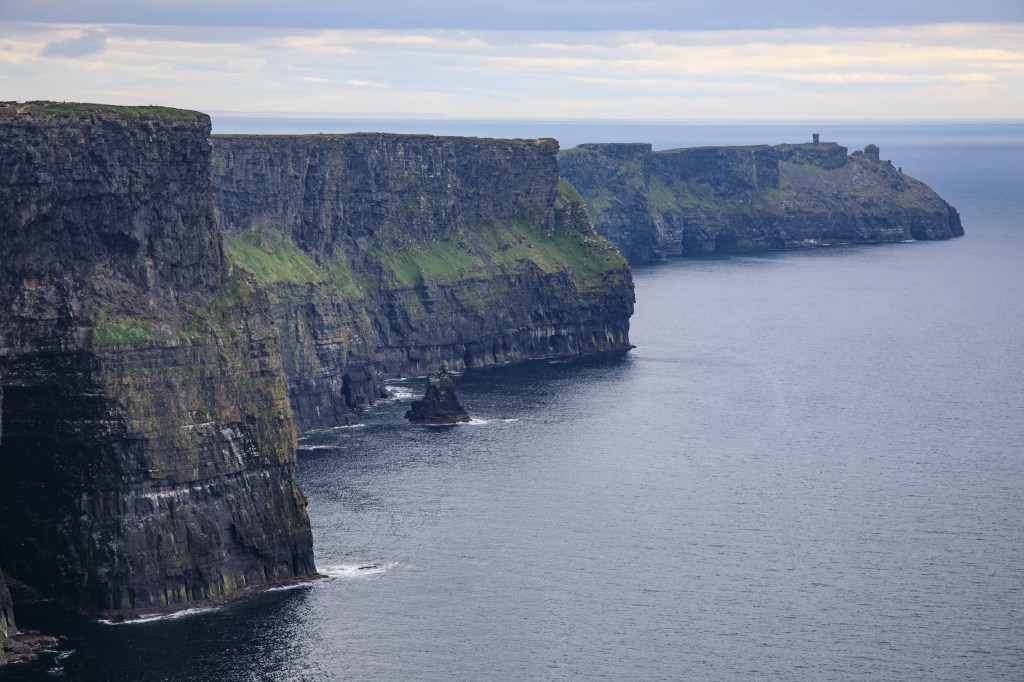
From the pastoral nostalgia of Bunratty, we drove further west until the earth abruptly terminates at the edge of the continent: the Cliffs of Moher. Peering over the precipice of this UNESCO Global Geopark, the sheer verticality and scale of the landscape are completely humbling. These monolithic columns of dark shale, siltstone, and sandstone drop over 700 feet into the churning, cerulean waters of the Atlantic Ocean, stretching for five miles along the Clare coastline. Geologically, these cliffs are the monumental remnants of a vast river delta formed over 320 million years ago during the Upper Carboniferous period. Standing at O’Brien’s Tower, the highest point of the ridge, we watched the relentless Atlantic swells fracture violently against the base of the stone giants. The air here is thick with a heavy, salt-laden mist and the echoing, symphonic roar of the ocean colliding with ancient rock. For a photographer, it is a masterclass in atmospheric perspective; the layered strata of the cliffs fade into a soft, ethereal blue as they curve toward the horizon, while thousands of nesting seabirds, including puffins and guillemots, wheel through the sky like tiny fragments of white paper caught in the coastal updrafts.


Tracing the Limestone Wilderness: The Wild Atlantic Way & The Burren
Leaving the sheer drops behind, we joined the Wild Atlantic Way, an iconic coastal route that is globally revered for a reason: it forces you to slow down and confront the raw, unedited intersection of land and ocean. This route carried us directly into the heart of The Burren, a surreal, 250-square-kilometer karst landscape that feels like an alien terrain pulled directly from the moon. Derived from the Irish word Boirinn, meaning “a rocky place,” this vast expanse was formed millions of years ago when ancient carboniferous limestone sheets were slowly uplifted from the ocean floor and subsequently carved by massive glacial sheets during the last Ice Age. Today, the landscape is a mesmerizing pavement of bare, grey limestone blocks known as clints, separated by deep, structural fissures called grikes. Despite its stark, monolithic appearance, the Burren possesses a delicate, paradoxical ecology. Peering into the deep, sheltered grikes, we discovered a vibrant botanical anomaly where Arctic, Alpine, and Mediterranean wild orchids and ferns bloom side-by-side in the micro-climate of the stone fissures. It is a stunning visual narrative of resilience, a landscape stripped of its soil, yet harboring an incredibly diverse, hidden tapestry of life that stretches all the way to the Atlantic shore before we finally turned inland toward the welcoming lights of Galway. We checked into the Galmont Hotel and Spa.


Day 5 – Galway

GALWAY

Day 5 – Galway captured our family’s heart over the final days of our trip, operating at a wonderfully relaxed, unhurried pace. We spent our mornings exploring the vibrant, stone-paved lanes of Shop Street and Kirwans Lane, stopping to admire the heavy, intricate weave of authentic sweaters at the Weavers of Ireland, and losing ourselves among the floor-to-ceiling shelves at Charlie Byrne’s Bookshop. We began our exploration of Galway at Eyre Square, a lively public park in the center of the city dedicated to John F. Kennedy. The green square features modern art installations like the iconic rusty iron sails of the Galway Hooker monument, honors local history, and serves as a bustling gateway to the pedestrianized shopping districts. From the square, we walked straight down the cobblestones of William Street and Shop Street, the city’s primary retail and cultural arteries. The narrow lanes are dense with old-world charm, lined with independent boutiques, bookstores, and historic storefronts.


As we continued down the lanes, the sound of traditional music drew us to the iconic Tigh Chóilí pub (locally known as Tigolli), a legendary family-run establishment on the corner of the Latin Quarter known for its bright red facade and daily live music sessions. Walking past the pub, we headed down toward the waterfront to the historic Claddagh basin, an ancient fishing village situated just outside the old city walls where the famous hands-and-heart Claddagh ring originated. Standing by the pier, we enjoyed a quintessential visual feast, taking in the iconic view of the Long Walk—a striking row of brightly painted, multi-colored houses standing shoulder-to-shoulder along the waterfront, their primary reds, blues, and yellows reflecting perfectly in the glass-like surface of the harbor pool. We walked further west along the coast to the Salthill Promenade, a scenic two-mile seaside walkway overlooking Galway Bay, where we watched local brave souls diving from the iconic Blackrock diving tower into the cold Atlantic surf.


Back at the basin, we spent some time exploring the vibrant Galway Farmers Market, browsing stalls loaded with local artisanal cheeses, hot bakes, and handmade crafts. A quick lunch of crepes, pizza slices and fruit filled us up. We then stepped through the Spanish Arch. Built in 1584 as an extension of the medieval city walls, this thick stone archway was designed to protect merchant ships docking at the nearby quays, which regularly traded wine and spices with Spain. Right next to the arch sits the modern, multi-story Galway City Museum. The space is remarkably progressive and inclusive, offering beautifully curated galleries on local maritime history, medieval artifacts, and science, alongside dedicated quiet rooms and sensory-friendly interactive stations specifically designed for neurodiverse children.


As a family navigating a strict vegetarian diet and severe food allergies, dining abroad often requires an intense level of planning. However, Ireland’s food culture blew us completely away with its proactive inclusivity. By law, every single menu we encountered featured explicit, detailed allergen numbering for every dish, turning what is normally a stressful task into a safe, welcoming experience. For dinner on our first night in Galway, we headed to Hyde Bar, where the vegetarian selections were outstanding, and their decadent Tiramisu was such an absolute hit that we returned three separate times just to order it. On Day 2, we grabbed a table at Dough Bros, which safely delivered what is easily some of the most phenomenal, blistered wood-fired pizza in Europe, served in a lively, casual atmosphere.


Our journey concluded with a final morning exploring the hidden bylanes of Galway before catching a comfortable, regional train back to Dublin. While there are numerous long-distance coaches operating between Dublin and Galway, the train network is incredibly smooth, running multiple times a day.
- The Pro-Tip: To ensure a completely stress-free experience when traveling through Ireland with children, always book your train tickets and major attraction entries online three to four weeks in advance. Seating assignments on Irish Rail and timed entry slots for landmarks like the Book of Kells fill up rapidly; having those digital confirmations in hand turns potential travel friction into a seamless transition.

Day 6 – Back to Dublin
Checking back into the InterContinental Dublin felt like arriving home; the staff had beautifully arranged a safe, thoughtful welcome-back spread of treats in our room, completely customized to be entirely sesame and nut-free. Reenergized, we set out to experience the city’s evening energy one last time. We walked the north side of the River Liffey to stand beneath the Spire, its massive 393-foot stainless steel needle reflecting the shifting twilight sky like a giant terrestrial lens. Wandering back across the water, we retraced our steps through the lively Grafton Street area, diving into the quieter, ambient lanes that skirt the walls of Dublin Castle. The soft glow of the gas lamps against the damp brickwork provided a perfect, reflective backdrop to contrast our days in the wild west with the deep urban history of the capital. We returned to Ballsbridge for a deep, restful sleep before catching our direct flight back to Chicago the following morning, our hand luggage packed with tangible memories from the airport stores.


Our week on the island was short, but it left an indelible mark on all of us, whispering promises of future journeys north toward Belfast and south through the coastal loops of Killarney and Dingle. Ireland we will be back.
Click to see all photos from Ireland – Ireland – #BeautifulWorld

